An agent swarm can produce a surprising amount of activity without making much progress. Four agents search, write reports, exchange opinions, and eventually agree. The shared folder fills up. The final answer may still rely on a missing relationship, an incompatible date, or one unsupported guess that traveled through several agents.
Adding a planner, researcher, critic, and editor gives that activity familiar names. It does not explain why their individual actions should improve the result. I wanted a more concrete account of organization:
Can a very simple rule for each agent, combined with a very simple rule for the group, make useful specialization emerge? What information must they share for that to work?
This led to a literature review, several mathematical models and exact checks, and a sequence of small language-model experiments. The most useful result is a conditional one. Simple local incentives can align individual improvement with team progress when contribution is well defined and observable. In open-ended tasks, reliably measuring that contribution becomes the difficult part.
The experiments did not identify a universal winning organization. Sharing raw evidence solved one additional question in an eight-question study, at higher token cost. In a later comparison with nearly equal measured cost, prioritizing verification produced one additional correct answer and one additional wrong submission. Those outcomes are worth understanding precisely because they resist a clean architecture success story.
I will separate three kinds of evidence throughout: established theory, exact checks in deliberately small mathematical worlds, and exploratory LLM measurements. None can substitute for the others.
Table of contents
Open Table of contents
- 1. Define progress before designing the organization
- 2. Useful roles describe operations and information
- 3. What related research says about communication
- 4. Full information cannot hurt an unconstrained optimum
- 5. A minimal mechanism with an actual guarantee
- 6. Better equilibrium guarantees can sacrifice steady progress
- 7. Information barriers can break the mechanism
- 8. Preserve provenance without mistaking it for truth
- 9. The real experiment: change visibility, then execute new actions
- 10. Make verification consume the same budget
- 11. Why a one-step contribution rule can fail even with perfect inference
- 12. Verification is the limiting interface
- 13. What organization I would test next
- 14. Evidence and reproducibility
- The design question that remains
1. Define progress before designing the organization
The recurring swarm problem is straightforward to state:
Given what the team has already learned, how should its next action add accepted progress toward the task, within the remaining budget?
This formulation makes several popular proxies look inadequate. A new document can repeat an old fact. A new fact can be irrelevant. A correct candidate can lack the evidence needed to justify it. A unanimous panel can share one mistaken premise.
For a retrieval task, it helps to distinguish the following objects:
| Object | Example | What it establishes |
|---|---|---|
| Observation | A versioned passage returned by a search or read | What the tool supplied |
| Hypothesis | This question may refer to a particular television adaptation | A candidate route to investigate |
| Supported relation | A passage connects an actor to a role in the specified adaptation | One link in the argument |
| Completed task | The answer satisfies the question’s required constraints | The actual objective |
The distinction is operational. An observation belongs in an evidence store. A hypothesis belongs in a candidate set. A supported relation needs its premises and scope. A completed task needs an acceptance rule. Putting all four into one undifferentiated conversation makes it easy for status to change without any new evidence.
Even the word better needs a definition. A system that answers more questions while also making more unsupported claims may or may not be an improvement. Accuracy, abstention, error cost, latency, and total inference cost should be specified before selecting an architecture.
2. Useful roles describe operations and information
There is a substantial literature on roles that has little to do with imitating human professions.
ROMA learns stochastic role representations that condition individual policies. Its regularizers encourage identifiable specialization in a multi-agent reinforcement-learning environment. RODE defines roles through restricted action spaces, learning action representations from their effects on the environment and other agents. A higher-level selector changes roles on a slower time scale.
The important transfer is the definition of a role: a constraint on what an agent observes, can do, or is responsible for producing. The empirical results of those papers involve trained policies, including StarCraft micromanagement tasks. They do not establish that changing the persona prompt of a frozen LLM produces the same kind of learned specialization.
GPTSwarm offers a useful LLM-specific representation. Nodes are operations, including model calls and other processing functions; edges carry information. Prompts and connections can be optimized. A node in such a graph does not need to be a persistent autonomous individual.
For a research system, I would start with a small operation vocabulary:
| Operation | Input | Output | Useful restriction |
|---|---|---|---|
| Acquire | An unresolved information need | New tool observations | Pay the actual search or execution cost |
| Connect | Existing observations | A candidate relation and its premises | Keep inference distinguishable from source text |
| Challenge | A candidate and its dependencies | A contradiction, failed test, or remaining gap | Target a specific claim |
| Commit | A proposed result and evidence | A versioned accepted item | Apply the task’s acceptance checks |
| Route | Current dependencies and available capacity | The next work allocation | Account for conflicts and remaining budget |
These are five operations, not a prescription to launch five agents. The same worker can acquire in one step and challenge in the next. A deterministic function may perform part of commit. An expensive semantic check may need a model. Specialization can follow tools, data access, and observed competence without turning every operation into a job title.
There are several different meanings of “the swarm evolves”
An organization can adapt during a task by changing assignments. A search procedure can improve an entire workflow across development tasks. A training algorithm can update worker or orchestrator policies. These are different optimization problems.
AFlow searches code-represented workflows using execution feedback. G-Designer generates task-conditioned communication topologies. These approaches make organization an optimization variable, but they do not by themselves prove that identical workers following a local rule will self-organize optimally during a single task. Their search and training costs also belong in a fair comparison.
The experiments in this post use frozen model calls with explicit information and action rules. They do not train emergent roles or evolve model weights.
3. What related research says about communication
The literature is more useful as a map of mechanisms than as a ranking of organizational charts.
| Research direction | Representative work | What it helps answer |
|---|---|---|
| Communication as a cost | AgentPrune, sparse debate topologies | Which messages and rounds can be removed in a tested protocol? |
| Information distributed across agents | SILO-BENCH | Can agents coordinate when relevant knowledge is separated? |
| Architecture interacting with task structure | Towards a Science of Scaling Agent Systems | How do coordination patterns behave on different task families? |
| Shared work state | Contract Net, blackboard systems | How are tasks advertised, selected, and integrated? |
| Replies with restricted visibility | LLM-based Multi-Agent Blackboard System | Can requests be public while candidate responses remain separated? |
| Debate versus independent aggregation | Should we be going MAD? | Does interaction add value beyond strong sampling and aggregation baselines? |
These papers change different things. Pruning messages is not equivalent to discovering semantic redundancy. A task-conditioned graph is not necessarily reorganized during execution. A successful blackboard system does not isolate the causal effect of hiding replies. A topology comparison can also change the controller, number of calls, stopping rule, or aggregation procedure.
The human collective-intelligence literature supplies an especially useful distinction. Facts and Figuring separates exploration of an information space from exploration of possible explanations. Its network experiment found that clustering could help the former while inhibiting the latter. Intermittent interaction experiments also show that the effects of communication depend on the interaction schedule and access to a participant’s own best solutions.
These are human experiments. They motivate separating facts, interpretations, and memory in an LLM study; they do not prove a particular masking schedule for language agents.
Engineering accounts point to similar concrete issues. Anthropic’s research-system report describes duplicate work and omissions when subtask boundaries are vague. Its parallel compiler-building account describes coordination through task locks, alongside a case where a common blocker limited useful parallelism. These are informative implementation reports, not controlled proofs that locks or a lead-agent hierarchy are generally optimal.
The resulting research question is narrower and testable: which information should change the next action, and what does sharing it cost?
4. Full information cannot hurt an unconstrained optimum
Before arguing for information barriers, we should rule out an overly strong claim.
Suppose an agent sees history in a restricted system and richer history in a fully informed system. Assume that , extra information is free, and the agent is allowed to ignore it. For every restricted policy , the richer system can implement
It can reproduce the restricted system exactly. The same construction applies to multiple agents and, by induction, to multiple rounds. Therefore,
This is a policy-class containment argument. It concerns the best feasible policy, not the behavior of a particular prompted model.
An actual LLM pays to read context. It may fail to ignore misleading material, adopt a peer’s framing, or spend its remaining budget reconciling redundant reports. Restricting its input can improve that bounded implementation. Such a result would demonstrate an interaction between information and the decision procedure; it would not show that information has intrinsically negative value.
There is an equally simple warning in the other direction. If the task is to output the XOR of two independent fair bits, seeing both permits perfect accuracy. Permanently hiding one limits any policy to one-half accuracy. Preventing conformity by withholding necessary evidence can destroy solvability.
The practical target is sufficient decision-relevant information at an acceptable cost. For some operations that may be a count or an identifier. For others it may be an entire dependency chain.
5. A minimal mechanism with an actual guarantee
Consider a deliberately restricted task family. There is a finite collection of work items , each with known nonnegative value . Agent chooses one feasible action from its finite action menu; that action covers a set of items. The team’s value is the value of the union:
Completing the same item twice does not double its value. The menus may differ across agents, representing different tools or capabilities. The model assumes we know which items an action covers; this is a strong assumption that we will later remove.
Give each agent its marginal contribution:
where is the configuration with agent removed. In a coverage task, this is the total value of items currently covered only by that agent.
The rules are small:
- Individual: change action only when doing so strictly increases your marginal contribution.
- Group: commit one such change at a time, using the current state, and eventually give every agent with an improvement the opportunity to act.
There is no requirement to invent different personalities. The system must implement the payoff correctly, and agents must respond to it. This is distributed utility design. It does not establish truthful reporting of private information, resistance to collusion, or compliance by an arbitrary LLM given a sentence about rewards.
Individual improvement equals team improvement
Hold the other agents fixed and let agent switch from to . Writing its utility change as ,
The counterfactual baseline cancels. The team’s value is an exact potential: every unilateral utility improvement increases it by the same amount. This identity works for any , not just coverage.
With finitely many configurations, strict increases cannot revisit a previous configuration. An improvement path therefore terminates. If profitable moves are reliably found and scheduled, the endpoint is a pure Nash equilibrium: no agent can improve by switching alone.
Termination is not an efficiency guarantee. The number of configurations can grow exponentially, and discovering a better feasible action can itself be expensive. The theorem has not paid for LLM deliberation, search, or checking.
Coverage gives a one-half equilibrium bound
Coverage has diminishing returns: adding a fixed action contributes no more when more items are already covered. This is submodularity.
Let be an equilibrium and an optimal feasible configuration. We may evaluate unions of agent-labeled actions as a mathematical intermediate, even though an agent cannot execute two alternative actions simultaneously. Monotonicity and diminishing returns give
At equilibrium, . Moreover, : exclusively covered items are counted once, and multiply covered items contribute nothing to that sum. Consequently,
This is a coverage specialization of the classical valid-utility framework associated with Vetta. It is not a new universal theorem about LLM swarms. In particular, one-half is a ratio of coverage values within the same action space, not a promise of 50% question-answering accuracy or an advantage over a single agent.
The bound can be attained. Let two items each have value one. Agent 1 can choose nothing or ; agent 2 can choose or . At , agent 1 gains nothing by duplicating , and agent 2 gains nothing by moving to . The configuration is an equilibrium of value one, although has value two. Moving between them requires an indifferent intermediate step or coordination.
The research checks enumerated 14,400 small coverage games, 115,200 unilateral changes, and 31,115 equilibria without violating the identities or bound. These are exact finite checks alongside a mathematical proof, not a proof assistant formalization and not LLM trials.
6. Better equilibrium guarantees can sacrifice steady progress
Marginal contribution is not the only simple local utility. Let be the number of agents covering item , and use a common reward table :
Marginal contribution uses and for . Equal sharing uses . An optimized table can improve the worst equilibrium within this coverage-game family. For four agents,
gives a worst-equilibrium ratio of . The utility design and its guarantees are established in Ramaswamy, Paccagnan, and Marden. The research independently checked rational certificates and tight examples for three reward rules at each agent count from two through six.
| Agents | Marginal contribution | Equal sharing | Optimized table |
|---|---|---|---|
| 2 | 1/2 | 2/3 | 2/3 |
| 3 | 1/2 | 3/5 | 7/11 |
| 4 | 1/2 | 4/7 | 31/49 |
| 5 | 1/2 | 5/9 | 55/87 |
| 6 | 1/2 | 6/11 | 1031/1631 |
The table describes worst-case equilibrium coverage, not observed language model success. The local rule needs only item values and accurate occupancy counts. Its potential is
Unilateral improvement increases , but need not equal . For a concrete example, let have value one and value three. Agent 2 always covers ; agent 1 chooses or . Under equal sharing, moving from to raises agent 1’s utility from one to , while the team’s coverage falls from four to three.
This distinction matters if the system has a deadline. Improving the worst eventual equilibrium and making every intermediate state better are different design objectives. Neither automatically maximizes useful work within eight tool calls.
7. Information barriers can break the mechanism
The potential argument relies on correct contribution estimates. Local visibility can invalidate them even when every agent follows the rule perfectly.
Take three agents, each choosing item or . Agent 0 sees only agent 1, agent 1 sees only agent 2, and agent 2 sees only agent 0. Each receives a perceived reward of one when its choice differs from the agent it observes, and zero otherwise.
Each wants to choose differently from its observed neighbor. Three such requirements cannot all hold on an odd cycle with two choices. There is no pure equilibrium. Worse, strictly improving asynchronous changes can cycle:
(y,x,x) → (y,y,x) → (x,y,x) → (x,y,y)
        → (x,x,y) → (y,x,y) → (y,x,x)
Each arrow changes one agent’s action and raises that agent’s perceived utility from zero to one. The perceived contributions no longer correspond to a shared team potential.
The finite visibility study checked 64 directed graphs across 216 action-menu combinations, or 13,824 games. The two directed three-cycles supplied the no-equilibrium examples in that family. This illustrates the distinction between a bound on equilibria and a guarantee that suitable dynamics reach one, also emphasized in utility design with arbitrary information networks.
Share the sufficient state for the decision
In the coverage model, an agent does not need all its peers’ reasoning. It needs the accurate occupancy of the items relevant to its alternatives, with its own occupancy handled correctly. Those counts are sufficient to recover the same marginal contribution as full action visibility.
This suggests a narrower public interface than broadcasting every report:
item identifier
current occupancy or reservation
accepted result and version
dependencies or conflicts relevant to the next action
The counts must describe a consistent current snapshot. A worker can compute a promising change against one version and discover at commit time that a peer has already taken it. Conflict checks are part of the mechanism.
Even full visibility does not rescue uncoordinated simultaneous changes. If two agents both cover , both may see a gain from switching to empty . If both switch together, neither gets unique coverage. They can oscillate between the two items. Serializing conflicting commits, or using a valid reservation protocol, addresses a different problem from merging messages.
Real work also has semantic overlap. Two differently worded subtasks may cover the same need; two identically named tasks may concern different versions. An occupancy counter cannot solve that interpretation problem.
8. Preserve provenance without mistaking it for truth
A separate simple rule helps with repeated evidence. Give each original observation a stable identifier and version. A derived message records the set of original observations on which it depends:
The receiving evidence store merges these sets by union. Because union is idempotent, commutative, and associative, retransmission, order changes, and multiple paraphrase paths do not create extra original observations. This is the basic algebra behind a grow-only set in the CRDT framework.
The rule solves provenance duplication. It does not make distinct sources independent or true. Two websites can repeat the same original reporting. Two separate test executions can legitimately produce identical text. Deduplicating by message wording or domain misses the causal distinction. Related repeated-information effects predate LLMs in the data-incest literature.
A small probability calculation makes the issue visible. Suppose three conditionally independent binary observations are each correct with probability , with a balanced prior. If the first observation appears three times in a five-message conversation, message-majority always follows that first observation and has accuracy . Counting the three unique observations gives MAP accuracy
At , the two accuracies are 75% and 84.375%. This is a comparison of specified mathematical decision rules. It does not predict that an LLM will naively count the duplicated message as three independent votes.
Indeed, a paired 48-call representation microbenchmark did not show that accuracy benefit. The model made the correct MAP decision on 24/24 raw-message cases and 23/24 deduplicated-board cases. The board used 20.99% fewer recorded tokens. That supports a cost observation for those inputs, not an accuracy improvement and not a general claim that summaries preserve everything.
Derived reasoning can still be useful. Even if it adds no new information to an ideal reasoner, it may save a bounded model substantial computation. Keep the reasoning available when helpful; keep its evidential lineage explicit.
9. The real experiment: change visibility, then execute new actions
To move beyond toy models, I used questions from BrowseComp-Plus with its frozen 100,195-document corpus. The local retrieval implementation used SQLite FTS5 BM25, returning up to four documents and a query-dependent passage of up to 2,200 characters per document. This differs from the official retrieval and grading stack, so the absolute scores are not an official benchmark reproduction.
The model request was gpt-5.4-mini with low reasoning effort. There was no
immutable model snapshot or controllable provider seed. Each complete policy
had an admission cap of 192,000 input-plus-output tokens and eight tool
requests. Equal caps did not force equal actual usage.
Eight question IDs were fixed before collection and had not been used in the earlier pilot. This was an ID-separated development set, not a topic-held-out sample or evidence of absence from model pretraining. Each condition had one trajectory per question.
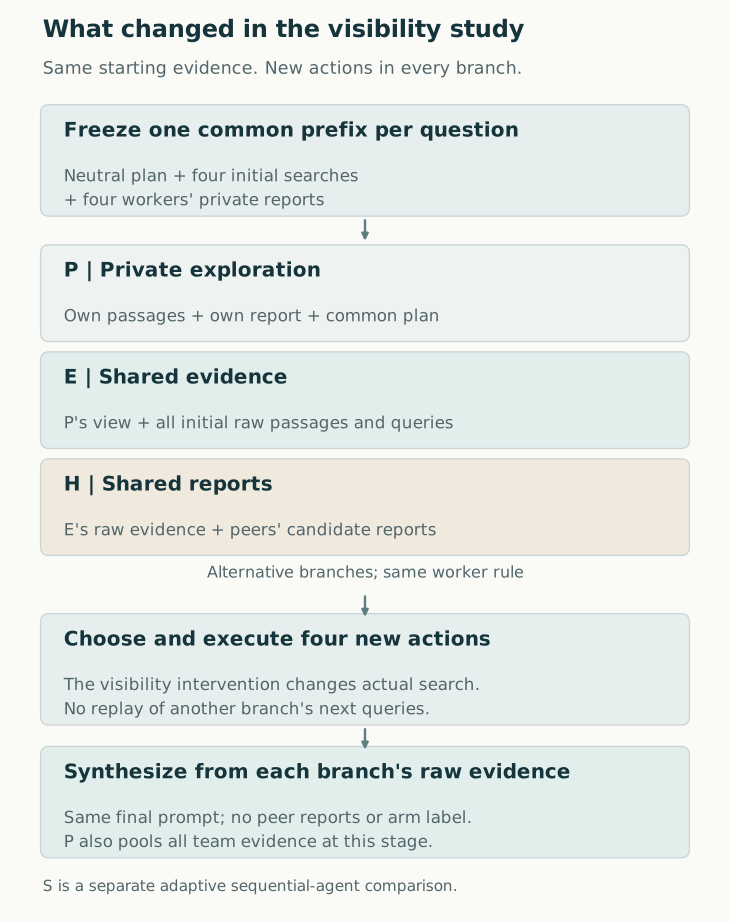
Four conditions, with a shared starting point
For the three swarm conditions, one neutral decomposition generated four initial searches. Each worker then wrote a private report about its own observations. That common prefix was frozen before branching.
| Condition | What a worker saw before its next action |
|---|---|
| P: private exploration | Common plan, its own passages, its own report |
| E: shared evidence | The same material plus all initial raw passages and executed queries |
| H: shared reports | The same raw evidence as E, plus peers’ candidate reports |
| S: sequential single agent | Its own adaptively acquired observations and action history |
Each P/E/H worker chose and executed a new action under its assigned visibility. I did not replay the old queries and pretend they represented a new policy. All workers used the same operational instruction: choose the next action most useful for resolving the root question’s outstanding constraints.
The final synthesizer received all raw observations actually acquired by its condition, with the same prompt and no arm label or peer reports. Thus P was private during exploration, but still aggregated the team’s evidence at the end. It was not a permanently disconnected system.
The observed gain was one question, with higher cost
| Condition | Correct | Wrong submission | UNKNOWN | Mean complete-policy tokens |
|---|---|---|---|---|
| P: private exploration | 1/8 | 1/8 | 6/8 | 67,458 |
| E: shared evidence | 2/8 | 0/8 | 6/8 | 96,118 |
| H: shared reports | 2/8 | 1/8 | 5/8 | 97,555 |
| S: sequential agent | 1/8 | 2/8 | 5/8 | 92,934 |
E’s additional success came from one question. Its average recorded token usage was about 42.5% higher than P’s. H did not solve an additional question beyond E. These counts do not establish a population-level benefit, noninferiority, or an optimal amount of sharing.
P/E/H used eight tool requests each; S averaged 6.5. Two S intermediate calls attempted an unavailable user-input tool and were retained as failures, with final synthesis continuing on available evidence. Consequently, this is also not a comparison against every possible strong sequential policy.
All correct final answers matched the reference after conservative normalization. Other substantive candidates were checked by two judges blind to the condition; they agreed. That agreement concerns equivalence to the benchmark short answer, not independent verification of every real-world claim in the reasoning.
A correct name can conceal a missing evidential link
The additional successful question involved identifying an actor through a television-adaptation chain. E acquired a passage explicitly connecting Benjamin Whitrow to Mr. Bennet in the 1995 adaptation of Pride and Prejudice. Its final answer had the relevant actor–role evidence.
H returned the same correct name, but the text and URLs supplied to its final synthesizer did not contain that name. Its citations did not establish the required actor–role relation. The output alone cannot tell us exactly whether the name came from parametric knowledge or some other internal inference.
I then repeated the final synthesis three times for each condition using byte-identical original inputs. E returned the correct name 3/3 times. H did so 2/3 times and once returned an actor from a different adaptation. P and S were each 0/3. This was a post hoc check of the one selected gain case; it measures neither fresh search-policy variability nor a general success rate.
The lesson is a measurement distinction:
The broader separation between answer correctness and citation support also appears in ALCE. A system can succeed on one dimension and fail on another.
10. Make verification consume the same budget
The visibility result suggested a practical intervention: once a plausible candidate exists, spend the next action on its most important missing relationship. But supplying an extra verification step after the baseline’s budget is exhausted would give the intervention a resource advantage.
I therefore ran a final-action comparison on the same eight development questions. For each question, I retained seven tool observations from the H trajectory and removed its remaining action, result, and original final answer. The retained second-wave actions had all originally depended only on the common initial evidence, so removing the fourth worker did not invalidate their histories.
A new shared diagnosis proposed a candidate and a critical missing relation. Both policies received exactly that diagnosis and the same raw prefix:
| Policy | Final-action instruction |
|---|---|
| B: free choice | Choose the most useful next action; verification, another search route, reading, and stopping are allowed |
| V: verification priority | Prefer establishing or refuting the candidate’s critical missing relation; fall back when no suitable candidate or gap exists |
B was allowed to verify. V did not receive privileged evidence. Each policy was sampled twice per question, its chosen tool action was actually executed, and a fresh final synthesizer saw only its raw evidence.
The full accounting included the old prefix, shared diagnosis, action selection, and final synthesis. The cap remained eight tools and 192,000 tokens. An additional N condition synthesized directly from the seven-tool prefix once per question. N is a useful ablation, but uses less actual resource and lacks the diagnosis cost.
One more correct answer, one more wrong answer
| Outcome | B: free choice | V: verification priority | N: seven-tool synthesis |
|---|---|---|---|
| Trajectories | 16 | 16 | 8 |
| Correct | 3 | 4 | 1 |
| Wrong submission | 0 | 1 | 0 |
| UNKNOWN | 13 | 11 | 7 |
| Mean complete-policy tokens | 125,644.75 | 125,578.19 | 82,823.75 |
| Mean tool requests | 7.9375 | 7.9375 | 7 |
| Intermediate protocol failures | 1 | 1 | 0 |
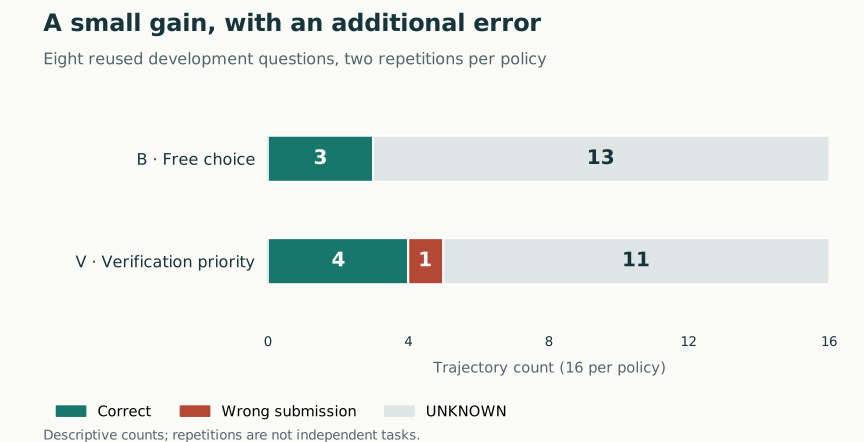
B and V differed in mean complete-policy token usage by only about 0.053%. That is observed cost similarity, not exact server-side token matching. Each suffered one unavailable-tool failure; both continued to final synthesis, and neither failure occurred on the question producing the correctness gain or the wrong submission.
Paired by question and replicate index, three pairs were jointly correct, one favored V, and twelve were jointly unsuccessful. The replicate index does not couple provider randomness. There are eight questions with repeated calls, not sixteen independent tasks. All paired final actions and evidence sets differed, so the experiment compares sampled prompted policies; it does not attribute every wording difference to the instruction alone.
The ranking depends on the cost of a wrong submission
As a post hoc sensitivity analysis, assign one point for a correct answer, zero for UNKNOWN, and for a wrong submission. Ignoring the tiny observed token-cost difference,
V scores higher if wrong answers carry no penalty, ties at , and scores lower at . This is not a new primary metric chosen to declare a winner. It shows why “a better group state” cannot remain undefined.
What the final actions actually revealed
Targeted relation retrieval sometimes worked. On the actor question, one B branch and both V branches searched the specific adaptation’s cast and retrieved the explicit missing actor–role relation. All three answered correctly. The other B branch pursued a different birth-year interpretation and abstained. These are three successes on one shared case, not three independent demonstrations. The cast passage also did not automatically validate every other clue in the question.
Finding a document was not enough. On another question, all four B/V searches found the relevant document, but the query-dependent extractor returned a bibliography-like passage rather than the needed coach–year relationship. A targeted read had recovered that relationship in an earlier diagnostic. In this experiment the document first appeared on the final tool call, so that additional read would exceed the budget. A different search query might have exposed the right passage immediately; the result does not prove that every one-call strategy must fail.
Verification instructions did not remove contradictory framing. One question required a university founded in the seventeenth century. The shared evidence placed the candidate university’s founding in 1477, yet several last actions continued searching around that candidate. The conflict was visible without consulting the reference answer.
A shared diagnosis could still supply a bad route. For a foundation question, all four searches pursued the same incorrect organization family. That is observed convergence on an unproductive hypothesis. Because the diagnosis itself was not experimentally varied, the data do not separately identify its causal anchoring effect.
Citation integrity remained imperfect. V’s one wrong submission cited documents about a different entity. Another V abstention included a nonexistent document identifier. A verification-priority prompt did not enforce a valid citation contract.
All 30 successful final actions selected search. None selected read or finish. The experiment therefore provides evidence about these search decisions, not a comprehensive evaluation of reading and stopping policies.
11. Why a one-step contribution rule can fail even with perfect inference
One tempting response is to improve the model’s estimate of which query will help most. Better estimates matter, but a second problem remains: some pieces of evidence are valuable only together.
The simplest coordination counterexample has two agents choosing zero or one. The team receives one only if both choose one. From , neither unilateral change has positive value. Marginal-contribution improvement can stop at zero even though the optimum is one. The potential identity still holds; the coverage-quality bound does not, because this objective has complementarity rather than diminishing returns.
Here is an information-acquisition version that makes the loss arbitrarily large, despite a known prior and exact Bayesian inference.
Let the answer be uniform over possibilities. Draw an independent uniform , and define
There are three equally priced queries, with budget for two:
| Query | Returned information |
|---|---|
| The value of | |
| The value of | |
| The answer with probability , otherwise an erasure |
The hint’s reveal event is independent of and . On its own, either share leaves the answer uniform, so immediate optimal answer accuracy remains . The hint raises expected accuracy to
A policy that greedily maximizes the next step’s expected answer accuracy therefore picks the hint. If it is erased, only one query remains, and one share still cannot reveal the answer. The greedy two-query value is
The optimal policy queries and , then computes . Its accuracy is one. Taking makes the greedy-to-optimal ratio tend to zero. At ,
These are synthetic mathematical values, not LLM measurements. Twenty-four finite instances were checked with rational arithmetic and exact adaptive decision trees, using the most favorable tie-breaking for greedy.
The counterexample explains the structural issue. Before seeing , learning has zero immediate decision value. After seeing , it has value . Its marginal value increases with the evidence already acquired.
Adaptive submodularity supplies useful greedy approximation guarantees when conditional marginal returns diminish. For the normalized, adaptive-monotone, adaptive-submodular cardinality-budget setting, exact adaptive greedy obtains the familiar guarantee. Those assumptions, including the probability model needed to evaluate conditional gains, do not come free with a natural-language prompt. The reference here is the corrected v5 text; minimum-cost coverage has additional conditions and different bounds.
Submodular Surrogates for Value of Information shows another principled route: construct a tractable surrogate for a specified decision problem. Its known probabilistic model and decision utility are substantive inputs, not a general-purpose verifier for open web research.
This is why a good organization may need to reserve a bundle of dependent actions. “Find the document, then inspect the relevant section” can be the useful unit, even when the first action has little immediate answer value.
12. Verification is the limiting interface
We can state a clean invariant for a shared result ledger. Fix a consistent, versioned evidence snapshot . A proposed claim arrives with supporting material . Accept it only when a verifier returns one.
If the verifier is sound,
and the initial accepted set contains only supported claims, then induction shows that every later accepted claim is supported. The agent’s persona is irrelevant to this invariant.
The premise is doing the work. A substring check can establish that a quoted span occurs in a source. It cannot establish that the span supports the particular relation, that an omitted qualifier is harmless, or that the source is correct. Source support is a claim relative to premises. World truth requires something further.
A post hoc relation-control experiment tested ten focal passage cases twice each. Controls included deleting the actor’s name, retaining a name while removing the needed relation, using the wrong adaptation, and substituting a fictional actor within an otherwise explicit relation. The 20 support labels matched the frozen case labels. All eight accepted cases supplied nonempty exact quotes. Two rejected-case explanations stitched text with ellipses and failed a continuous-substring check.
That is evidence of a local capability to distinguish these supported and unsupported relations. It is not a general soundness certificate, an independent test distribution, or a demonstration that the system can discover all missing relationships end to end.
More reviewers do not automatically give independent checks
If all reviewers fail on the same latent ambiguity with probability , requiring all of them to accept can still have error probability , not . Fresh sessions remove shared conversation history; they do not automatically remove common training data, priors, or interpretation errors.
A valid probabilistic ledger guarantee can instead assume an error bound at each step conditional on the entire past:
Then the union bound gives
Independence is unnecessary for that argument. What is necessary is a valid conditional error bound. A model’s self-reported confidence does not establish one. This connects directly to the distinction between verifier design and verified verifier performance in the site’s horizon-scaling study.
Contribution estimates have the same hidden requirement
Suppose every relevant utility estimate satisfies on the state being evaluated. An estimated improvement exceeding must be a true improvement, because estimating the old and new actions introduces at most difference error.
If all candidate changes have been checked and none exceeds that threshold, every true unilateral gain is at most . The coverage argument then yields
This is a useful robust statement. It also makes the missing premise explicit: we need an error guarantee across the relevant alternatives and states. A handful of correct critiques cannot provide that uniform guarantee.
Why finite black-box tests cannot certify arbitrary future tasks
Let be the finite set of situations already validated. A situation includes a task, its history, and an action whose contribution is being estimated. Choose an unobserved future situation .
Without restrictions on the task family, distribution, or contribution function, two models can agree on every observation in while satisfying
The same observations induce the same estimate at . But
so at least one compatible world has error at least one-half. More finite tests enlarge ; absent further structure, another unobserved case remains.
This argument limits a distribution-free, uniform future guarantee. It does not make the observed labels arbitrary, and it does not say that empirical research must stop. Specifying a task distribution permits statistical generalization claims. Restricting tasks to a formal environment can permit sound checking. What fails is upgrading finite open-ended demonstrations into a guarantee about every future semantic contribution.
The bottleneck is consequently more precise than “we need smarter agents.” The mechanism needs a sufficiently reliable relationship between its local score and actual task value, including the cost of learning that value.
13. What organization I would test next
The evidence suggests a concrete design hypothesis: a small public state for coordination and accepted evidence, with exploration views selected by the dependencies of each action. The worker rule can remain the same across agents.
| Shared state | Why it is useful |
|---|---|
| Task constraints | Expose incompatible dates, versions, entities, and required outputs |
| Observations with provenance | Reuse evidence without counting paraphrases as new observations |
| Candidate status and unresolved relations | Separate plausible routes from accepted conclusions |
| Active reservations and dependencies | Avoid conflicting work and budget for multi-step acquisition |
| Accepted artifacts and their versions | Integrate results against an explicit acceptance contract |
An illustrative loop is short:
read the current task and relevant shared state
propose an action or dependent action bundle
check that its reservation is still valid
execute within the remaining budget
attach observations and claim-level provenance
apply acceptance checks and update the shared state
This is a protocol sketch, not a claim that its semantic components have been solved. “Propose a useful action” still requires judgment. “Apply acceptance checks” still depends on the task’s verifier. The point is to make those interfaces observable and replaceable, rather than hide them inside a personality description.
The communication structure should follow the work. Independent document partitions can be explored separately before aggregation. Competing updates to the same resource need coordinated commits. A multi-hop evidence chain needs dependency-aware acquisition. A tightly coupled implementation task may need a shared interface contract and frequent integration.
Permanent all-to-all broadcasting, fixed isolated teams, and a deep hierarchy are all too coarse to answer these different needs with one choice. The right unit of design is often an operation and its dependencies, rather than the agent as a permanent organizational node.
Two baseline lessons keep this proposal honest.
First, static partitioning can already solve some coordination problems. If one useful item is uniformly hidden among locations and the team can inspect distinct locations without other clues, the best evidence-finding probability is . A preassigned disjoint partition can attain it. A dynamic swarm cannot claim credit merely for avoiding duplicates that a static assignment also avoids.
Second, literal duplicate queries may not be the actual waste. In 24 earlier retrieval traces, 208 requests contained no exact duplicate requests, while 157 of 832 returned passage occurrences had already appeared within their task. Ten queries returned only previously seen passages. That does not mean 18.87% of total tokens were avoidable: query outcomes were unknown in advance, passages differed in length, and the rest of the prompt had its own cost. The problem was overlapping information acquisition, which is harder to predict than identical request strings.
A stronger next experiment
I would choose a bounded task family with independently checkable outcomes, freeze the utility assigned to errors and abstention, and compare the proposed protocol against a strong sequential agent, static disjoint allocation, and shared-index retrieval. The comparison should account for full inference usage, tool costs, and end-to-end latency, including any controller or workflow-search overhead.
The most informative task manipulation would vary dependency structure: separable coverage, substitutable evidence, complementary evidence pairs, and conflicting writes. It would test whether the proposed organization helps in the regime its mechanism predicts. Policy selection would stay on development data, followed by new held-out tasks and repeated runs.
That would turn “this organizational chart feels intelligent” into a claim about an identifiable mechanism, a specified objective, and a measured operating regime.
14. Evidence and reproducibility
The main numerical claims in this post come from the following distinct stages. The exploratory stages should not be pooled into one apparent sample of independent tasks.
| Stage | Scope | Main result or purpose |
|---|---|---|
| Coverage and visibility mathematics | Finite exact checks plus analytic arguments | Conditional alignment and equilibrium bounds; explicit cycles |
| Provenance representation microbenchmark | 24 paired cases, 48 model calls | Raw 24/24 versus board 23/24; lower board token usage |
| Real visibility intervention | 8 fixed questions × 4 policies | P/S 1/8, E/H 2/8; E used more tokens |
| Fixed-input synthesis check | One post hoc question, 12 calls | Correctness varied even with unchanged supplied evidence |
| Relation controls | 10 post hoc cases × 2 calls | 20/20 support labels; two rejected-case explanations failed exact quoting |
| Budgeted final action | 8 reused questions, B/V twice and N once | B 3/16 correct, V 4/16 correct with one wrong submission |
| Complementary-query counterexample | 24 exact Bayesian instances | One-step decision-value greedy can have a ratio approaching zero |
An earlier checkpoint pilot also failed to establish an advantage for hiding the existing answer during recomputation: reuse and blind recomputation each produced 15/42 correct outputs, while fresh exploration produced 16–17/42 depending on the judge. It motivated controls; it is not confirmatory support for information isolation.
The visibility study and its subsequent synthesis, relation, and final-action controls recorded 4,413,767 input-plus-output tokens, including grading. This includes cached input in the reported usage and excludes the older pilot and provenance microbenchmark. It is not a dollar estimate. The final action stage alone recorded 1,621,813 new collection-and-grading tokens. Complete-policy totals separately charge each policy for reused prefixes; those totals must not be mistaken for newly incurred collection usage.
The public companion files provide aggregate measurements and compact per-trajectory outcomes, a runnable exact-theory check, and scope and reproduction notes. The companion script rechecks the stated small mathematical examples and resource-pattern certificates using the Python standard library. It does not rerun LLM inference or reproduce the entire original enumeration.
The public extract contains no source-corpus redistribution or raw model sessions. Readers can recompute the published counts and small mathematical examples; the extract alone cannot independently replay the complete LLM collection. The source corpus and official retrieval implementation are available from BrowseComp-Plus. Exact model-output replication is additionally limited by the unpinned provider snapshot and unavailable sampling seed.
The design question that remains
A productive agent swarm needs a causal connection between local action and shared progress. In a coverage game, marginal contribution supplies that connection exactly. Accurate resource counts make a small information interface sufficient. Provenance union prevents a repeated observation from turning into fictitious additional evidence.
Open-ended work stretches each assumption. The value of a query may be unknown until execution. Two individually unhelpful observations may solve the task together. A candidate can be correct without its supporting relationship being present. A verifier can accept a persuasive statement whose premises do not establish it.
The most useful organization is therefore one whose information flow, dependencies, and acceptance conditions match the task well enough that individual work can be measured and integrated. Establishing that match is the research problem. Giving the agents more elaborate titles does not establish it.